---
title: A Guide On The Best Shoes For AFO Brace Wearers
description: Find the best AFO friendly shoes for foot drop, cerebral palsy, and stroke. Designed for AFO brace wearers with removable insoles and extra-width support.
image: https://blog.anodyneshoes.com/hubfs/1-Sep-16-2024-09-03-14-0244-PM.jpg
---
Free Shipping!
- [Login](https://www.anodyneshoes.com/scs/checkout.ssp?is=login&login=T&fragment=login-register&_ga=2.139944311.594202185.1705327965-1966822928.1699636057#login-register)
- or [Register](https://www.anodyneshoes.com/scs/checkout.ssp?is=register&login=T&reset=T&newcust=T&fragment=login-register&client_id=1199613585.1708380270&session_id=1719409087&_ga=2.45544804.1172352323.1719240659-1199613585.1708380270&_gac=1.258274936.1716234967.Cj0KCQjw8pKxBhD_ARIsAPrG45k9qU5DfAG8y_1QdNe8IHWhfV_eqn7H2BBlnEOM62vuRDJpu_0TWhsaAuXdEALw_wcB#login-register)
[](http://www.anodyneshoes.com/)
- [WOMEN](https://www.anodyneshoes.com/women)
- [Shoes](https://www.anodyneshoes.com/women/shoes)
- [Sport](https://www.anodyneshoes.com/women/shoes/sport)
- [Trail](https://www.anodyneshoes.com/women/shoes/trail)
- [Casual](https://www.anodyneshoes.com/women/shoes/Casual)
- [Slippers](https://www.anodyneshoes.com/women/slippers)
- [Sandals](https://www.anodyneshoes.com/women/sandals)
- [Socks](https://www.anodyneshoes.com/women/socks)
- [Insoles](https://www.anodyneshoes.com/women/insoles)
- [Multi Density Orthotics](https://www.anodyneshoes.com/women/insoles/womens-multi-density-orthotics)
- [Gel Insoles](https://www.anodyneshoes.com/women/insoles/gel-insoles)
- [Rx Inserts](https://www.anodyneshoes.com/women/insoles/rx-insoles)
- [MEN](https://www.anodyneshoes.com/men)
- [Shoes](https://www.anodyneshoes.com/men/shoes)
- [Sport](https://www.anodyneshoes.com/men/shoes/sport)
- [Trail](https://www.anodyneshoes.com/men/shoes/trail)
- [Casual](https://www.anodyneshoes.com/men/shoes/Casual)
- [Slippers](https://www.anodyneshoes.com/men/slippers)
- [Sandals](https://www.anodyneshoes.com/men/sandals)
- [Socks](https://www.anodyneshoes.com/men/socks)
- [Insoles](https://www.anodyneshoes.com/men/insoles)
- [Multi Density Orthotics](https://www.anodyneshoes.com/men/insoles/mens-multi-density-orthotics)
- [Gel Insoles](https://www.anodyneshoes.com/men/insoles/gel-insoles)
- [Rx Insoles](https://www.anodyneshoes.com/men/insoles/rx-insoles)
- [ALL](https://www.anodyneshoes.com/accessories)
- [Shoes](https://www.anodyneshoes.com/accessories/shoes)
- [Slippers](https://www.anodyneshoes.com/accessories/orthopedic-slippers)
- [Sandals](https://www.anodyneshoes.com/accessories/orthopedic-sandals)
- [Socks](https://www.anodyneshoes.com/accessories/orthopedic-socks)
- [Diabetic Socks](https://www.anodyneshoes.com/accessories/orthopedic-socks/diabetic-socks)
- [Bunion Socks](https://www.anodyneshoes.com/accessories/orthopedic-socks/bunion-socks)
- [Insoles](https://www.anodyneshoes.com/accessories/orthopedic-shoe-insoles)
- [Multi Density Orthotics](https://www.anodyneshoes.com/accessories/orthopedic-shoe-insoles/multi-density-orthotics)
- [Gel Insoles](https://www.anodyneshoes.com/accessories/orthopedic-shoe-insoles/gel-insoles)
- [Rx Insoles](https://www.anodyneshoes.com/accessories/orthopedic-shoe-insoles/rx-insoles)
- [Shoe Care](https://www.anodyneshoes.com/accessories/shoe-care)
- [Education](https://www.anodyneshoes.com/accessories/Education)
- [Supplier](https://www.anodyneshoes.com/accessories/supplier)
- [Displays](https://www.anodyneshoes.com/accessories/supplier/displays)
- [Collateral](https://www.anodyneshoes.com/accessories/supplier/collateral)
- [Impression Foam](https://www.anodyneshoes.com/accessories/supplier/impression-foam)
- [SHOP CONDITIONS](https://www.anodyneshoes.com/shop-by-condition)
- [Diabetes](https://www.anodyneshoes.com/shop-by-condition/diabetic-shoes)
- [Neuropathy](https://www.anodyneshoes.com/shop-by-condition/shoes-for-neuropathy)
- [Bunions](https://www.anodyneshoes.com/shop-by-condition/shoes-for-bunions)
- [Swollen Feet](https://www.anodyneshoes.com/shop-by-condition/shoes-for-swollen-feet)
- [Hammertoe](https://www.anodyneshoes.com/shop-by-condition/shoes-for-hammertoe)
- [Heel Pain](https://www.anodyneshoes.com/shop-by-condition/shoes-for-heel-pain)
- [Plantar Fasciitis](https://www.anodyneshoes.com/shop-by-condition/shoes-for-plantar-fasciitis)
- [Flat Feet](https://www.anodyneshoes.com/shop-by-condition/shoes-for-flat-feet)
- [Heel Spurs](https://www.anodyneshoes.com/shop-by-condition/shoes-for-heel-spurs)
- [Charcot Foot](https://www.anodyneshoes.com/shop-by-condition/shoes-for-charcot-foot)
- [SHOP FEATURES](https://www.anodyneshoes.com/shop-by-feature)
- [Slip-Resistant Shoes](https://www.anodyneshoes.com/shop-by-feature/slip-resistant-shoes)
- [Arch Support Shoes](https://www.anodyneshoes.com/shop-by-feature/arch-support-shoes)
- [Strap Closure Shoes](https://www.anodyneshoes.com/shop-by-feature/strap-closure-shoes)
- [Therapeutic Shoes](https://www.anodyneshoes.com/shop-by-feature/therapeutic-shoes)
- [No Tie Lace Shoes](https://www.anodyneshoes.com/shop-by-feature/no-tie-lace-shoes)
- [Vegan Friendly Shoes](https://www.anodyneshoes.com/shop-by-feature/vegan-friendly-shoes)
- [Extra Wide Shoes](https://www.anodyneshoes.com/shop-by-feature/extra-wide-shoes)
- [Shoes for AFO's & Braces](https://www.anodyneshoes.com/shop-by-feature/shoes-for-afos-braces)
- [Wide Toe Box Shoes](https://www.anodyneshoes.com/shop-by-feature/wide-toe-box-shoes)
- [Stretchable Shoes](https://www.anodyneshoes.com/shop-by-feature/stretchable-shoes)
- [Extra Depth Shoes](https://www.anodyneshoes.com/shop-by-feature/extra-depth-shoes)
- [Double Depth Shoes](https://www.anodyneshoes.com/shop-by-feature/double-depth-shoes)
- [Shoes With Removable Inserts](https://www.anodyneshoes.com/shop-by-feature/shoes-with-removable-inserts)
- [Motion Control Shoes](https://www.anodyneshoes.com/shop-by-feature/motion-control-shoes)
- [Shoes With Heel Counter Stability](https://www.anodyneshoes.com/shop-by-feature/shoes-with-heel-counter-stability)
- [LOCATIONS](https://www.anodyneshoes.com/locations)
- [ABOUT US](https://info.anodyneshoes.com/our-story)
- [Our Story](https://info.anodyneshoes.com/our-story)
- [Our Products](https://info.anodyneshoes.com/product)
- [Our Lab](https://info.anodyneshoes.com/laboratory)
- [Our Blog](https://blog.anodyneshoes.com)
-
-
-
Go
# What Are AFO Braces & Why Do They Need Special Shoes
Posted by [Billy Kanter, CPED](https://blog.anodyneshoes.com/author/billy-kanter) on Oct 30, 2024 12:00:00 PM

Find me on:
[LinkedIn](https://www.linkedin.com/in/billy-kanter-a73b74101/)
- [Tweet](https://twitter.com/share)
If you’ve been told you need an AFO, or you’re helping a child, parent, or partner adjust to one, you’re probably asking the same question: why does an ankle and foot brace that’s meant to help with walking suddenly make shoes feel impossible? An AFO brace (also called an ankle foot orthosis) changes the shape, volume, and support needs of your foot and ankle, which is why regular footwear often feels tight, unstable, or hard to put on.
In this guide, we’ll break down what an AFO is and why the right pair of ankle foot orthosis shoes matters for comfort, stability, and everyday activities.

## What Is an AFO?
AFO stands for Ankle-Foot Orthosis, a custom or pre-made brace designed to support the ankle and foot. AFOs are commonly prescribed by doctors for children and adults with a wide range of medical conditions, including:
- Cerebral palsy
- Muscular dystrophy
- Spina bifida
- Stroke
- Multiple sclerosis
- Foot drop (caused by nerve damage)
- Post-surgery rehabilitation
The main function of an AFO brace is to provide stability, improve walking mechanics, and support or correct the position of the foot and ankle. The device wraps around the ankle and extends under the foot, helping to control foot positioning, ankle movement, and, in some cases, knee alignment.
## How do AFOs Work?
AFOs are designed to assist with a variety of movement difficulties, depending on the wearer’s condition. In general, they serve to:
1. **Improve Stability:** People with weak muscles in the lower leg or foot may experience instability while standing or walking. An AFO brace supports the joint, preventing the ankle from collapsing or turning, which can reduce the risk of falls or injury.
2. **Control Range of Motion:** Some conditions cause an individual to have too much or too little movement in their ankle. For instance, individuals with cerebral palsy may have spasticity that causes excessive muscle contractions, making it hard to walk normally. An AFO brace helps limit abnormal motion, guiding the foot and ankle into a more functional position.
3. **Prevent Foot Drop:** Foot drop is a condition where the front part of the foot cannot be lifted properly during walking due to nerve or muscle damage. An AFO brace helps lift the foot during the swing phase of walking, preventing the foot from dragging and improving the individual’s ability to walk smoothly and safely.
4. **Support Correct Alignment:** Children or adults with conditions that affect their bone or muscle development may have feet or ankles that grow out of alignment. An AFO brace supports the foot in the correct position, which can aid in proper musculoskeletal development.
5. **Assist with Muscle Weakness:** If an individual has significant muscle weakness, the AFO brace can serve as a structural support, helping them stand or walk without overworking their muscles. This allows for more comfortable and effective movement.
## Types Of AFOs
There are several types of AFOs, each designed to address specific needs. These include:
- **Solid AFOs:** Provide maximum stability by limiting ankle movement. They are often prescribed for individuals with significant muscle weakness or spasticity.
- **Hinged AFOs:** Allow some controlled movement at the ankle joint. These are suitable for individuals who need assistance with dorsiflexion (lifting the foot) but still require some ankle flexibility.
- **Dynamic AFOs (DAFOs):** These lightweight ankle and foot braces allow for more movement while providing support. They are typically used for children with mild motor impairments to encourage natural foot and ankle movement while offering support.
- **Posterior Leaf Spring AFOs:** Designed to support foot drop, this type of AFO is lightweight and flexible, allowing for more natural ankle movement during walking.
## [Why Do AFOs Need Special Shoes](https://www.anodyneshoes.com/shop-by-feature/shoes-for-afos-braces)?
While an AFO brace provides essential support and functionality for the foot and ankle, choosing the right AFO friendly shoes to pair with the device is equally important. Regular shoes aren’t typically designed to accommodate the unique shape and structure of an AFO, which can make it difficult for individuals to wear both the brace and standard footwear comfortably. Here’s why special ankle foot orthosis shoes are necessary:
#### 1. Accommodation for Size and Shape
AFOs often make the foot bulkier, requiring shoes that are larger or wider than typical footwear. Many off-the-shelf shoes are too narrow or don’t have enough room in the toe box to accommodate both the foot and the brace. Wearing shoes that are too tight over an AFO brace can lead to:
- Discomfort or pain
- Skin irritation or pressure sores
- Reduced blood circulation
- Damage to the AFO itself
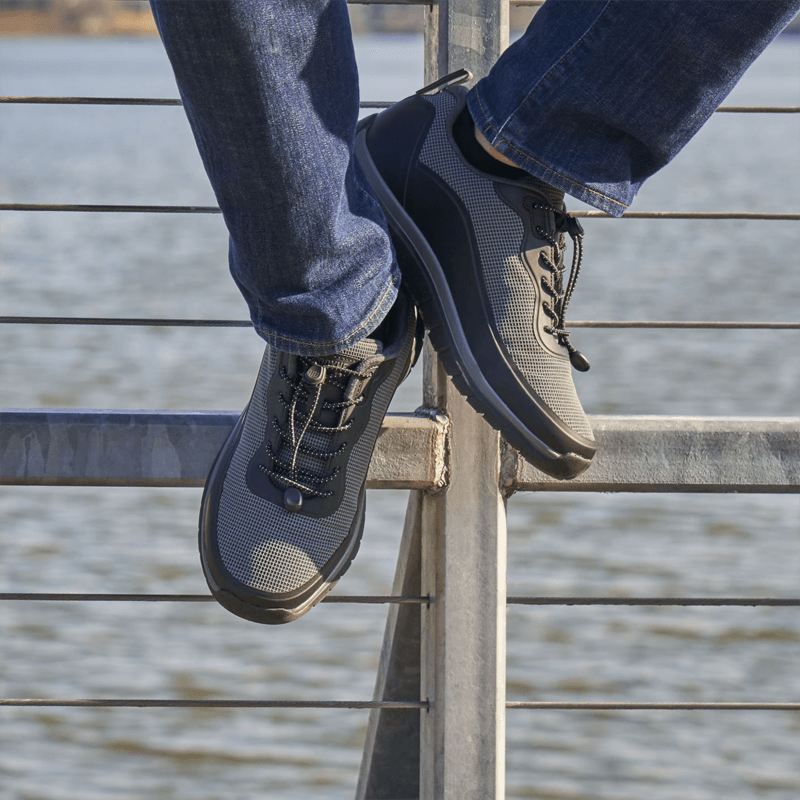
[No. 16 Men's Sport Sprinter](https://www.anodyneshoes.com/no-16-sport-sprinter?quantity=1&width=2&color=1&size=8)
Special shoes designed for AFO brace wearers offer a wider and deeper fit to comfortably accommodate both the foot and the orthosis. These shoes also have adjustable features, such as Velcro straps that are usually longer or [elastic laces](https://www.anodyneshoes.com/shop-by-feature/shoes-for-afos-braces/closure-type/Elastic-Laces), making it easier to secure the shoe around the AFO without compromising on comfort or fit.
#### 2. Enhanced Stability and Support
AFOs are designed to stabilize the foot and ankle, but the wrong footwear can negate their benefits. Shoes that are too flimsy, lack a proper heel counter, or have poor traction can increase the risk of falls and make walking difficult.
Shoes made for use with AFOs provides [extra stability](https://www.anodyneshoes.com/shop-by-feature/shoes-with-heel-counter-stability) through features like:
- Firm heel counters to support the back of the foot
- Supportive soles that prevent excess movement
- Slip-resistant treads for improved traction on various surfaces
These features ensure that the individual can walk confidently and safely, whether they’re using their AFO indoors or outdoors.
#### 3. Correct Alignment and Posture
One of the primary functions of an AFO brace is to guide the foot and ankle into proper alignment, especially for individuals with gait abnormalities or muscle imbalances. However, regular shoes with a poorly designed sole or incorrect heel height can throw off this alignment.
Special shoes for AFO wearers often come with removable insoles or custom-molded footbeds that help maintain the correct posture and alignment of the foot. This is crucial for preventing long-term issues like joint pain, back problems, or further deformities in the lower limbs.
#### 4. Easy Accessibility
For children or adults wearing an AFO brace, putting on and taking off shoes can be a challenge. A standard lace-up shoe may not provide enough room to comfortably slip the foot and brace inside, leading to frustration and discomfort.
Footwear designed for AFO wearers often features wide openings and adjustable closures like Velcro straps or zippers, allowing the shoe to open up fully. This makes it easier for individuals to put on and remove their shoes without straining or damaging the AFO.
## Features to Look For In AFO-Compatible Shoes
When choosing shoes for a loved one who wears an AFO brace, it’s important to consider several key features to ensure comfort, functionality, and support. Here’s what to look for:
1. [Extra Depth](https://www.anodyneshoes.com/shop-by-feature/extra-depth-shoes): Extra-depth shoes provide \\(1/4\\) to \\(1/2\\) inch more depth in the toe box and instep.
2. [Width](https://www.anodyneshoes.com/shop-by-feature/extra-wide-shoes): Shoes need to provide enough space to accommodate both the AFO and the foot without causing pressure points or tightness. Most shoe brands carry only one width (M), while Anodyne or specialized shoe brands carry extra wide widths up to 6E for men and 4E for women. The shoes are wider all around from heel to toe, not just at the toe area.
3. Adjustable Closures: Look for shoes with Velcro straps, zippers, or [elastic laces](https://www.anodyneshoes.com/shop-by-feature/no-tie-lace-shoes) that make it easy to get the shoes on and off while allowing for a snug fit around the brace.
4. Removable Insoles: Shoes with removable or customizable [insoles](https://www.anodyneshoes.com/accessories/orthopedic-shoe-insoles) allow for further adjustments to the fit and can accommodate orthotic inserts if needed.
5. **Durable, Supportive Construction:** Choose shoes with firm heel counters, sturdy soles, and good arch support to ensure stability during walking and other activities.
6. [Non-Slip Soles](https://www.anodyneshoes.com/shop-by-feature/slip-resistant-shoes): Traction is key for preventing slips and falls, especially for individuals with mobility challenges. Look for shoes with slip-resistant soles.
7. **Breathable Materials:** Because AFOs can make the foot feel warm and constricted, choose shoes made from breathable materials that allow air circulation to keep feet dry and comfortable.
8. **Stretch Uppers:** A stretch upper (like knit or stretch mesh) helps the shoe accommodate the added volume of an AFO brace and reduces “hot spots” where rigid materials would otherwise rub. Look for uppers that stretch across the forefoot and instep but still pair with a supportive structure (a firm heel counter and stable sole) so the foot and brace don’t slide around. Avoid uppers that are overly tight or have bulky seams over the brace area, since that can create pressure points and make the shoe harder to put on and take off.
## Anodyne Shoes for AFO
AFOs play an important role in helping individuals with mobility challenges maintain stability, improve walking mechanics, and enhance their overall quality of life. However, wearing an AFO brace without the right footwear can lead to discomfort, improper alignment, and increased risk of injury. That’s why it’s essential to choose shoes that are specifically designed to accommodate AFOs.
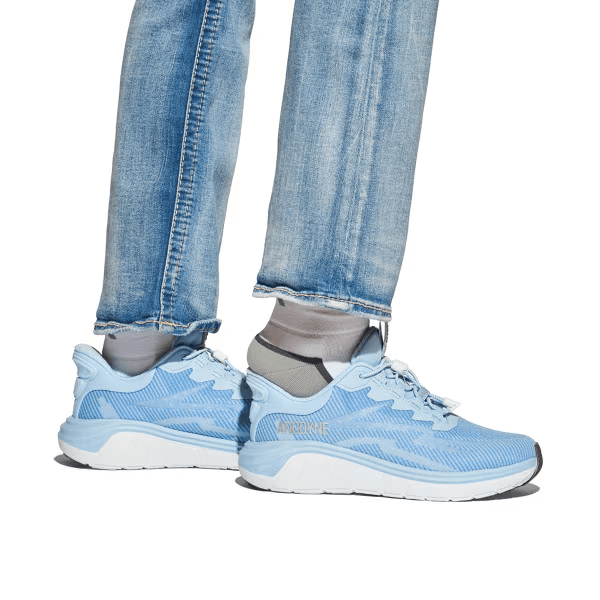
[No. Women's 59 Sport Dash](https://www.anodyneshoes.com/No.-59-Sport-Dash?quantity=1&width=2&color=35&size=6)
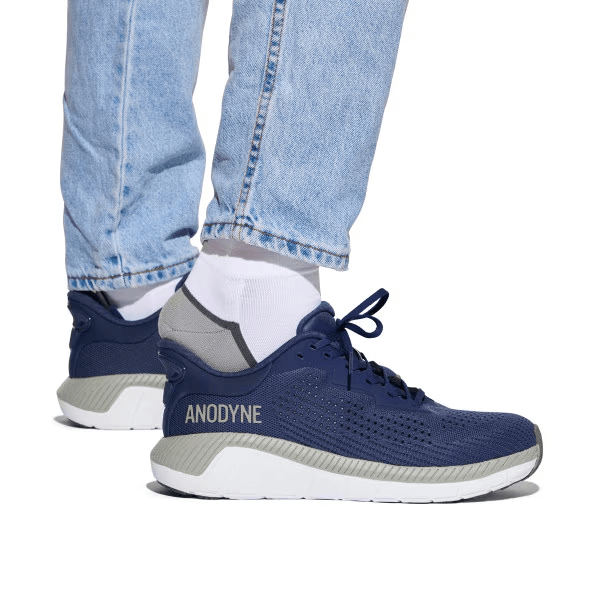
[No. 24 Men's Sport Move](https://www.anodyneshoes.com/No.-24-Sport-Move?quantity=1&width=2&color=34&size=8)
Whether you have severe spasticity requiring maximum plastic or carbon fiber support, or moderate needs with additional support, [Anodyne](https://www.anodyneshoes.com/)'s collection offers solutions in multiple sizes and widths for women and men—from small to large, and everything in between. Anodyne shoes for AFO feature:
- Removable insoles that accommodate custom orthotics of any length or trim
- Velcro straps for easy donning and secure fit
- Extra depth and width for your foot and brace
- Mesh materials for breathability
- Available in high and low profile styles for your desired aesthetic
We carry medium, small, and extended sizes with a bit of extra room that makes all the difference in comfort.
Work with your physician to balance your medical needs with lifestyle demands. Anodyne's expert team will help you compare styles, [contact us](https://www.anodyneshoes.com/contact-us) with specific questions, and find shoe recommendations tailored to your condition's severity. We're here to help you achieve the additional support and comfort you deserve.
## Frequently Asked Questions
### What are AFO shoes?
Shoes for AFO are specially designed footwear that accommodate ankle foot orthosis braces. AFO shoes feature:
- extra depth and width for proper fit
- Velcro straps or zippers for easy donning; removable insoles to position custom orthotics; reinforced heel counters for stability
- mesh panels for comfort and breathability
- non-slip soles for safe walking
- wide toe boxes.
- Flexible uppers.
Available in multiple colors, sizes, and widths for women and men, our AFO shoes provide support for conditions like stroke, cerebral palsy, foot drop, multiple sclerosis, and Charcot Marie Tooth.
### What is the 3 shoe rule?
The 3 shoe rule recommends rotating three pairs of shoes to extend their lifespan and maintain comfort.
For shoes for AFO, this means:
- Pair 1 is your primary shoes worn daily with your brace
- Pair 2 rotates in for variety and allows cushioning recovery
- Pair 3 provides backup when others need cleaning or repair.
All three pairs must be AFO shoes with Velcro straps, removable insoles, extra depth, and stability features.
### Are AFO braces the same as foot and ankle braces?
Not always. “Ankle brace” and “foot brace” are often used as general terms, but an AFO (ankle-foot orthosis) is typically a more structured medical-grade brace that supports both the foot and ankle and often extends up the lower leg.
Compared with many standard ankle braces that mainly provide compression or mild stabilization around the ankle joint, an AFO brace is designed to provide external stabilization and help control ankle/foot positioning (commonly for issues like foot drop).
If you’re unsure which foot and ankle brace you need, or whether you need AFO shoes versus regular shoes, your physician or orthotist can confirm the right brace type and the footwear requirements based on your gait, range of motion, and support needs.
Topics: [Anodyne Blog](https://blog.anodyneshoes.com/topic/anodyne-blog), [Lifestyle](https://blog.anodyneshoes.com/topic/lifestyle), [Foot Care](https://blog.anodyneshoes.com/topic/foot-care)
.png?width=116&name=Anodyne_circle_1_logo%20(2).png)
Born and raised in the emergent city of Milwaukee, Wisconsin, Anodyne represents the core of an age-old Midwestern culture – pride, dedication and hard work. We’re a group of designers, fit experts, pedorthists, and most importantly, a group of friends that share a common goal.
### Stay up-to-date with our blog!
### Recent Posts
### Posts by Tag
- [Lifestyle (162)](https://blog.anodyneshoes.com/topic/lifestyle)
- [Patient (155)](https://blog.anodyneshoes.com/topic/patient)
- [Anodyne Blog (99)](https://blog.anodyneshoes.com/topic/anodyne-blog)
- [Recipes (46)](https://blog.anodyneshoes.com/topic/recipes)
- [Practitioner (41)](https://blog.anodyneshoes.com/topic/practitioner)
- [Diabetic Foot Care (37)](https://blog.anodyneshoes.com/topic/diabetic-foot-care)
- [Diabetes Blog (32)](https://blog.anodyneshoes.com/topic/diabetes-blog)
- [Foot Care (30)](https://blog.anodyneshoes.com/topic/foot-care)
- [Diabetic Shoes (24)](https://blog.anodyneshoes.com/topic/diabetic-shoes)
- [Diabetes Awareness (18)](https://blog.anodyneshoes.com/topic/diabetes-awareness)
- [Diabetes Diet (18)](https://blog.anodyneshoes.com/topic/diabetes-diet)
- [Custom Inserts (10)](https://blog.anodyneshoes.com/topic/custom-inserts)
- [Medicare Paperwork (9)](https://blog.anodyneshoes.com/topic/medicare-paperwork)
- [Anodyne Shoes (8)](https://blog.anodyneshoes.com/topic/anodyne-shoes)
- [Anodyne Scanner (3)](https://blog.anodyneshoes.com/topic/anodyne-scanner)
- [Neuropathy (2)](https://blog.anodyneshoes.com/topic/neuropathy)
- [Online Webinars (1)](https://blog.anodyneshoes.com/topic/online-webinars)
See all
Back to Top

-
-
-
- PRODUCTS
- [Women](https://www.anodyneshoes.com/women)
- [Men](https://www.anodyneshoes.com/men)
- [Slippers](https://www.anodyneshoes.com/accessories/orthopedic-slippers)
- [Socks](https://www.anodyneshoes.com/accessories/orthopedic-socks)
- [Sandals](https://www.anodyneshoes.com/accessories/orthopedic-sandals)
- [Inserts](https://www.anodyneshoes.com/accessories/orthopedic-shoe-insoles)
- HELP
- [Contact Us](https://www.anodyneshoes.com/contact-us)
- [FAQ](https://www.anodyneshoes.com/faq)
- [Become a Supplier](https://info.anodyneshoes.com/become-a-supplier)
- [Guest Order Status](https://www.anodyneshoes.com/guestorderstatus)
- [Shipping and Returns](https://www.anodyneshoes.com/shipping-and-returns-supplier)
- ABOUT US
- [Our Story](https://info.anodyneshoes.com/our-story)
- [Products](https://info.anodyneshoes.com/product)
- [Blog](https://blog.anodyneshoes.com/)
- [Laboratory](https://info.anodyneshoes.com/laboratory)
- LEGAL
- [Medicare](https://info.anodyneshoes.com/medicare)
- [Terms and Conditions](https://www.anodyneshoes.com/terms-and-conditions)
- [Privacy Policy](https://www.anodyneshoes.com/privacy-policy)
© 2019 Anodyne, LLC. All rights reserved.
 
```json
{
"@context" : "https://schema.org",
"@type" : "BlogPosting",
"author" : {
"@type" : "Person",
"name" : "Billy Kanter, CPED",
"url" : "https://blog.anodyneshoes.com/author/billy-kanter"
},
"dateModified" : "2026-02-12T10:23:13.048Z",
"datePublished" : "2024-10-30T17:00:00.000Z",
"headline" : "A Guide On The Best Shoes For AFO Brace Wearers",
"image" : [ "https://blog.anodyneshoes.com/hubfs/1-Sep-16-2024-09-03-14-0244-PM.jpg" ],
"mainEntityOfPage" : {
"@id" : "https://blog.anodyneshoes.com/what-are-afos-and-why-do-they-need-special-shoes",
"@type" : "WebPage"
},
"publisher" : {
"@type" : "Organization",
"logo" : {
"@type" : "ImageObject",
"url" : "https://blog.anodyneshoes.com/hubfs/Anodyne_A_logo-1.png"
},
"name" : "Anodyne"
}
}
```